News of a European legal victory over patent disputes ignited expectations that the long-standing "Halozyme risk" is finally dissipating. Meanwhile, SamChunDang Pharm, which recently experienced a roller-coaster ride over U.S. Food and Drug Administration (FDA) developments, joined the rebound, although market skepticism remains strong regarding the actual substance of its catalyst.
|

Alteogen Prevails in European Patent Battle..."IP Risk Substantially Cleared"
According to KG Zeroin MP Doctor, Alteogen closed at 302,500 won on the day. During the trading session when the sidecar was triggered, the stock surged as much as 13.62% to hit 304,500 won. Considering that the stock had tumbled from its peak of over 520,000 won early this year to nearly half due to royalty controversies and patent dispute concerns, today's sharp rise is interpreted as a signal that the patent risks weighing down the market are clearing.
The primary catalyst originated in Europe. The District Court of The Hague in the Netherlands dismissed a preliminary injunction request filed by competitor Halozyme against Alteogen's partner, MSD (Merck & Co.). Halozyme had requested that Keytruda SC (subcutaneous formulation, commercialized as Keytruda Qurex) be excluded from drug price lists in Denmark and Sweden pending a final verdict on the merits, but the request was rejected. The product incorporates ALT-B4, Alteogen's proprietary hyaluronidase (PH20)-based drug formulation platform. This decision contrasts with a 2025 Munich court ruling that granted Halozyme an injunction blocking the product's release in Germany, signaling that the tide in European litigation is shifting in favor of MSD.
In the United States, Alteogen's position has also solidified. On May 12, the U.S. Patent Trial and Appeal Board (PTAB) invalidated Halozyme’s core patent (US 11,952,600). The tribunal ruled that claiming rights over all 6,753 variants based solely on data from a single PH20 variant constituted an excessively broad scope. Subsequently, three related family patents were also invalidated, marking Halozyme’s fourth patent defeat in the U.S. Furthermore, Halozyme's petition for an inter partes review targeting Alteogen’s manufacturing process patent (US 12,221,638) was denied at the institution stage.
However, a final hurdle remains as oral arguments for a patent infringement lawsuit filed by Halozyme against Keytruda SC in the U.S. District Court for the District of New Jersey are scheduled for July 31.
Kim Seon-ah, an analyst at Hana Securities, noted "The invalidation trial initiated by Halozyme concluded with a final decision of invalidity, and the remaining 14 family patents are sequentially following the same path to invalidation. In the United Kingdom, the dispute ended as Halozyme withdrew its patent, while in Germany, a case seeking to revoke the preliminary injunction order remains pending."
|
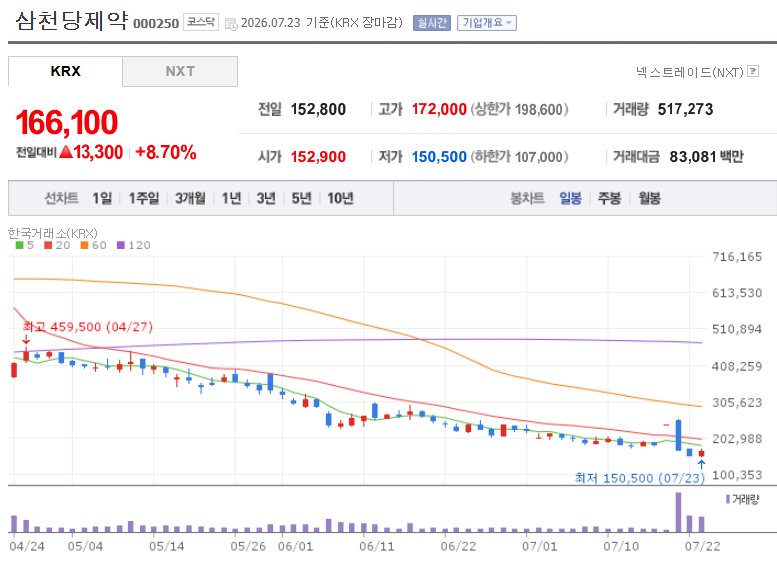
SamChunDang Pharm Rebounds on FDA Expectations..."Question the Substance"
SamChunDang Pharm closed up approximately 8.2% at 165,400 won, rebounding for the first time in four trading days. While driven by sector-wide strength in Kosdaq bio stocks and bargain hunting, analysts warn that it is premature to view this rebound as sustainable given the recent extreme volatility.
Earlier this year, SamChunDang Pharm's stock skyrocketed from the 200,000-won range to an intra-day high of 1,233,000 won on March 30, fueled by hype surrounding "oral obesity treatments." The surge briefly propelled the company to the top spot in Kosdaq market capitalization as an "emperor stock." However, shortly after reaching its peak, the company was designated an unfaithful disclosure corporation in April for distributing marketing materials instead of formal public disclosures regarding sales performance details for its Eylea biosimilar in Canada. The stock subsequently plummeted over 86% from its March peak to hit a lower limit of 167,800 won on July 21. An investor who put 100 million won into the stock at its peak would have seen their holdings shrink to approximately 13.58 million won.
According to data from NH Investment & Securities, as of July 16, the average purchase price for retail investors in SamChunDang Pharm stood at approximately 448,441 won, with 94.6% of total investors incurring heavy losses.
The recent volatility was triggered by FDA-related announcements. On July 20, the company announced it had received a "Pre-ANDA" response from the FDA—a preliminary consultation process prior to submitting an Abbreviated New Drug Application (ANDA) for its oral semaglutide generic—sending the stock straight to its daily upper limit of 239,000 won. Highlighting that the response assigned a meeting tracking number and designated Novo Nordisk's Rybelsus as the reference listed drug (RLD), the company emphasized that "regulatory uncertainties have been substantially resolved."
However, the rally lasted less than a day. As the company refused to disclose the full text of the response citing business confidentiality, the market lost the ability to verify the grounds for the alleged "resolution of uncertainty," causing the stock to plunge to its lower limit on July 21. Lee Jae-won, an analyst at Yuanta Securities, diagnosed: "The refusal to disclose the original document reignited market suspicion, erasing all of the previous day's gains."
The core issue is that the practical significance of this event falls far short of what the terminology implies. Crucially, the FDA itself drew a clear line. The agency clarified that accepting a Pre-ANDA meeting request does not constitute a determination that the product is eligible for ANDA submission, nor does it confirm that the proposed development approach is acceptable.




![‘암살자(들)' 이민호 사는 70억 빌라…알고 보니 육영수 아파트 터[누구집]](https://image.edaily.co.kr/images/vision/files/NP/S/2026/10/PS26101000224t.jpg)