



This article was released as Pharm Edaily Premium Content on October 29, 2026, at 7:20 AM.
[Yu Jin-hee, Edaily Reporter] As the domestic stock market navigates through a mixed consolidation phase, a sharp divergence in fortunes is emerging across the pharmaceutical, biotechnology, and medical device sectors. Rather than chasing speculative optimism, investor capital is increasingly concentrating on companies that validate their value through tangible global orders and regulatory milestones.
|

P&S Robotics Expands into Upper-Limb Rehabilitation Following Latin American Deals
According to the Korea Exchange on October 28, P&S Robotics and LivsMed ranked among the top 30 daily gainers across the domestic market. In stark contrast, Moa Life Plus plunged to its daily lower limit (down 29.78%), weighed down by fragile financials and mounting administrative issues.
Data from financial intelligence platform KG Zeroin MP Doctor showed that P&S Robotics hit the daily upper limit, surging 29.95% to close at 5,120 KRW. LivsMed also rallied strongly, jumping 16.98% (up 6,300 KRW) to finish at 43,400 KRW. Conversely, Moa Life Plus cratered to 257 KRW. The market sent a decisive signal, clearly distinguishing high-tech medical robotics firms with real revenue traction from distressed, marginal players.
P&S Robotics, which went public on the Kosdaq in July 2024, specializes in wearable exoskeleton rehabilitation robots. Its flagship product, the Walkbot, provides customized gait training by coordinating three primary lower-limb joints: the hip, knee, and ankle.
During the first half of the year, product sales accounted for 92.6% of the company's total revenue, with overseas exports driving 79.6% of sales. The stock's recent rally was ignited by major contract momentum from the Teletón Foundation, Mexico’s largest rehabilitation network operating 27 specialized medical centers across the country.
After delivering its initial unit in May, P&S Robotics secured an additional supply contract in July worth 2.56 billion KRW—equivalent to approximately 33% of its entire 2025 revenue (7.6 billion KRW). By replacing incumbent competitors' equipment in these centers, the company has positioned itself for further order expansion across the Americas.
Product diversification is also gaining momentum. The company is branching into upper-limb rehabilitation with its Healerbot, designed for patients with shoulder mobility impairments such as frozen shoulder and rotator cuff tears. Following a public sector demonstration project in August, the device was deployed across three domestic hospitals.
The Healerbot has also obtained European CE MDR (Medical Device Regulation) certification, clearing key regulatory hurdles for international distribution. At CES 2027 in January, P&S Robotics plans to introduce hybrid and consumer-focused home prototypes alongside its clinical platforms, broadening its scope into B2C markets.
While the company posted an operating loss of 800 million KRW in the first half of the year due to overseas delivery delays and upfront R&D investments, its balance sheet remains solid with approximately 27.7 billion KRW in cash reserves. The conversion of major Latin American backlogs into realized revenue is expected to drive a sharp earnings recovery.
"With Walkbot at our core, the vast majority of our revenue is generated through overseas exports," an official from P&S Robotics stated. "We will continue to bolster our core competencies to enhance our global market presence."
|
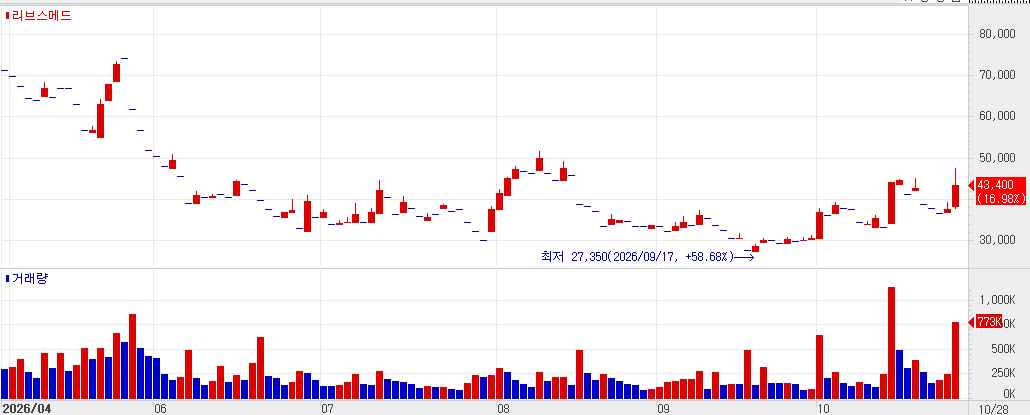
LivsMed Targets Global Big Markets with Multi-Joint Surgical Robot ‘STARQ’
With medical device innovators gaining heightened attention, LivsMed is drawing institutional and retail interest on the back of its proprietary engineering. Its primary revenue driver, ArtiSential, is a handheld articulating laparoscopic instrument featuring an end-effector that bends freely up to 90 degrees in all directions, mimicking the natural dexterity of human wrists. The technology has established a robust clinical presence, used routinely by over 600 surgeons across 250 domestic general hospitals.
LivsMed has now mounted this multi-joint technology onto robotic arms to introduce its next-generation laparoscopic surgical robotic platform, STARQ. The move directly challenges Intuitive Surgical’s Da Vinci, which has long commanded roughly 90% of the 15 trillion KRW global surgical robotics market.
STARQ resolves key operational drawbacks associated with both Da Vinci’s centralized tower architecture and Medtronic Hugo’s decentralized cart layout. By implementing two mobile carts equipped with dual robotic arms deploying in a top-down configuration, STARQ can be integrated into operating rooms without requiring facility renovations.
Its pricing model presents another significant competitive moat. A hospital can acquire multiple STARQ units for the cost of a single Da Vinci system. Furthermore, by cutting single-procedure disposable instrument costs by more than half, LivsMed significantly lowers the economic barrier for mid-sized hospitals to adopt robotic surgery.
STARQ has submitted its marketing approval application to the Ministry of Food and Drug Safety (MFDS), with domestic clearance anticipated as early as December. LivsMed has also accelerated its international roadmap, transitioning from a sequential rollout to simultaneous market entries across the United States and Japan.
To meet anticipated commercial demand, the company acquired industrial facility sites in Yongin, Gyeonggi Province, and is accelerating plant setup. Leveraging 135.8 billion KRW raised through its initial public offering, LivsMed plans to construct a second manufacturing hub to support large-scale mass production.
"STARQ is an advanced robotic system that delivers best-in-class multi-joint performance for surgical operations," an official from LivsMed commented. "With superior clinical functionality and cost efficiency, we aim to open a new chapter in the global surgical robotics landscape."
In stark contrast, Moa Life Plus hit the lower limit as market participants abandoned the stock amid failing technical competitiveness and eroding financial stability.
The Kosdaq Market Division of the Korea Exchange recently disclosed that Moa Life Plus was cited for an additional administrative issue due to its sub-threshold market capitalization. As a result, the company faces dual administrative flags: trading below the 1,000 KRW penny-stock threshold and failing to maintain a market capitalization above 20 billion KRW.
Under exchange regulations, companies placed under administrative watch for market cap or share price deficits face formal delisting procedures if they fail to resolve these criteria within a designated 90-trading-day grace period. With no clear turnaround catalyst in sight, Moa Life Plus saw its shares tumble to 257 KRW.
"The process of separating viable enterprises from non-viable ones in the bio and healthcare sectors has grown far more rigorous," noted Soon-jae Hong, CEO of BioBook. "Capital continues to reward companies with sound balance sheets and verified global order backlogs, while non-viable firms lacking tangible pipelines face immediate exit pressure."